

Background & The Operational Challenge
Apex Regional Healthcare operates 4 specialized campus facilities delivering oncology, cardiology, neurology, and trauma care. Prior to partnering with KSPL, patient admissions and OPD discharge workflows relied on decentralized software instances: emergency triage records were maintained on one database, laboratory pathology results on another, and inpatient pharmacy billing on a third siloed system.
During peak morning OPD hours, average patient admission wait times exceeded 45 minutes, emergency room triage transfer suffered lag, and manual record collation created friction during national accreditation audits.
Clinical Informatics Bottlenecks & Regulatory Friction
In tertiary multi-specialty healthcare, data latency translates directly into clinical outcomes. Before our modernization roadmap, physician rounds across ICU wards were constrained by manual data consolidation. Specialists routinely waited for physical paper charts or had to log into disparate desktop consoles to view laboratory biochemistry results, radiology PACS imaging, and medication history.
This fragmentation created acute operational friction:
- Diagnostic Collation Delays: Blood chemistry panels took up to 3.5 hours to be transcribed into clinical ward records, slowing critical patient care decisions.
- Prescription Verification Gaps: Bedside nurses had to manually cross-reference paper medication orders against pharmacy stock sheets, increasing vulnerability to drug-drug interaction oversights.
- Accreditation Collating Burden: Collating audit trails for NABH, ISO 15189, and regulatory credentialing consumed hundreds of physician hours prior to every compliance assessment.
Every clinical touchpoint — triage triage vitals, automated biochemistry feeds, digital imaging, bedside physician notes, and insurance pre-authorization — is structured around a cryptographically secure, unified patient ID conforming to FHIR Release 4 and ABDM standards.
KSPL Healthcare Modernization Architecture
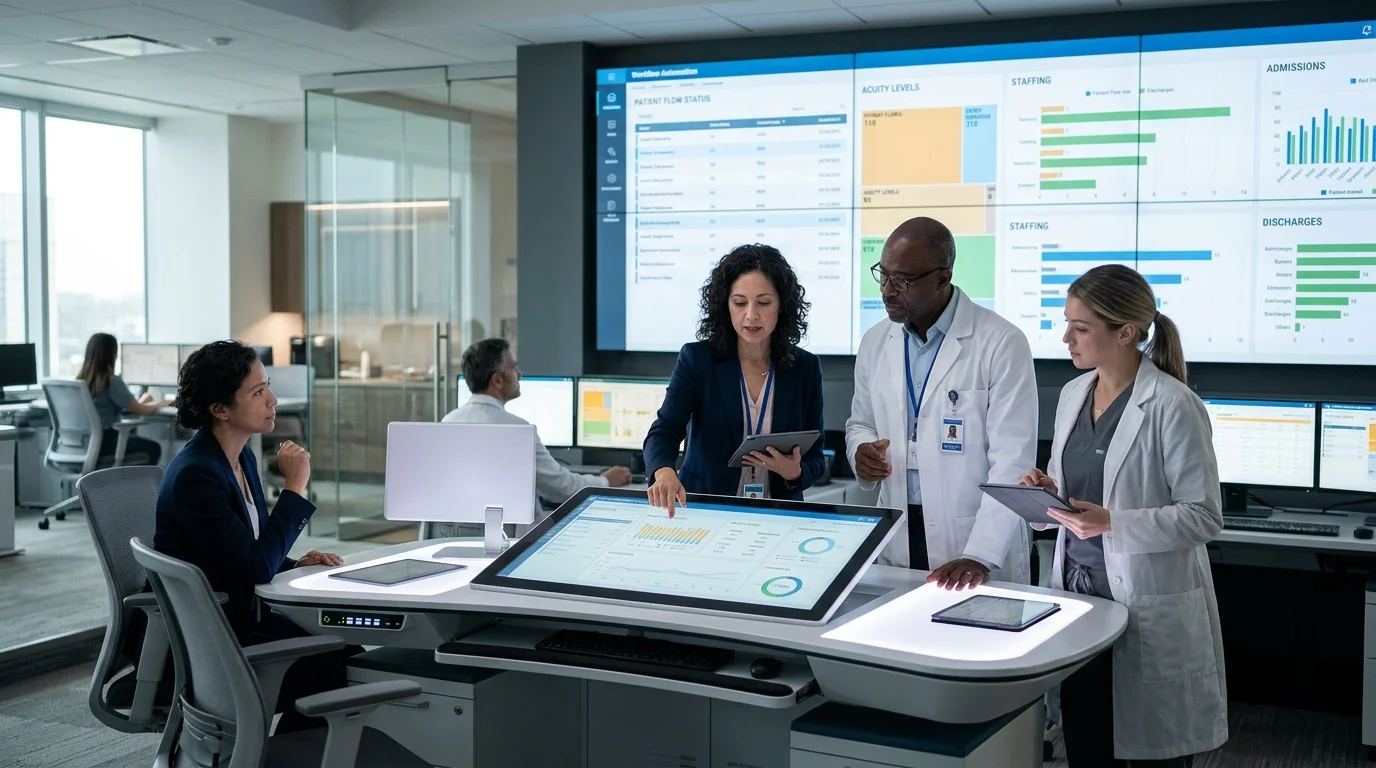
Kanishk Services deployed a centralized, FHIR R4-compliant Electronic Health Record (EHR) data platform integrated directly with laboratory instruments and PACS imaging servers:
- Real-Time Fast Healthcare Interoperability Resources (FHIR) Gateway: Unified patient demographics, diagnostic history, and billing records under a cryptographically protected Master Patient Index (MPI).
- Mobile Clinician & Nursing Station Tablets: Enabled attending doctors and ICU nurses to review real-time vitals, order prescriptions, and verify drug interaction warnings at bedside.
- Automated NABH & Ayushman Bharat (ABDM) Integration: Standardized health records for immediate linkage with India's Ayushman Bharat Digital Mission (ABDM) via secure M1/M2/M3 milestone APIs.
"The impact on clinical precision has been profound. Our specialists can now review MRI scans, pathology panels, and cardiac telemetry concurrently from any console in the hospital within 3 seconds of scan completion." — Dr. V. K. Nambiar, CMO
Measurable Clinical & Financial Impact
Within 6 months of facility-wide rollout, patient intake wait times plummeted from 45 minutes to under 9.5 minutes. Bed turnover optimization increased inpatient admission capacity by 14%, and automated billing auditing eliminated insurance pre-authorization claim rejections by 81%.